Vous n'êtes pas identifié(e).
Pages : 1
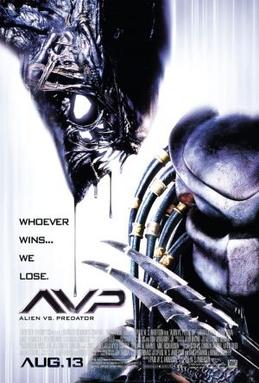
Alien VS Predator
Crédits officiels :
- Réalisation - Paul W.S Anderson
- Scénario - Paul W.S Anderson
- Histoire - Paul W.S Anderson & Dan O'Bannon & Ronald Shusett
Les invités ne peuvent voter
Hors ligne
Je n'ai pas revu ce film depuis des années, je ne vais donc pas prétendre en faire une critique et je ne vais pas non plus voter au sondage pour l'instant. Je voulais juste dire que ce film m'avait favorablement impressionné lors de sa sortie en 2004, car Paul W.S. Anderson avait réussi, AMHA, un tour de force. Celui de proposer un film tout à fait correct et même bon sur la base d'un picth éminemment nanar : littéralement Alien contre Predator.
Bien davantage qu'une adaptation des jeux vidéo d'horreur, il s'agit juste de la rencontre des deux monstre sacrés orchestrée par un mec qui à l'air de vraiment les aimer d'amour et qui a fait ça avec beaucoup de respect et d'ingéniosité. Avec un budget moyen (50 ou 60 millions de dollars je ne sais plus) le spectacle est très bon, la justification de la rencontre est pertinente et cohérente avec les mythologies des deux saga (du moins à l'époque). Bref, j'avais adoré et je l'ai revu régulièrement avec toujours autant de plaisir.
Le second volet est nettement moins bon, même s'ils n'est pas dénué de qualités. Toutefois, un éventuel troisième volet, teasé à la fin de AVP2 et que j'attendais de pied ferme ne verra probablement jamais le jours en raison du projet tout nul de Ridley Scott. C’est bien dommage.
Hors ligne
Avp vaut mieux que tous les films Alien et les films Predator, premiers volets exceptés.
Hors ligne
en raison du projet tout nul de Ridley Scott
Avp vaut mieux que tous les films Alien et les films Predator, premiers volets exceptés.

Dernière modification par Prelogic (22-01-2020 16:41:22)
Pour empêcher les peuples de raisonner, il faut leur imposer des sentiments
Hors ligne
Ouaip, je suis loin de détester AVP et effectivement c'était pas une rencontre facile à organiser mais le film n'a rien de mémorable. Les personnages sont nazes, ce n'est pas viscéral pour un sous (au point de se demander si c'est bien le même réal' que Horizon). Maintenant le spectacle est parfois assez cool (le climax avec la Reine est chouette) et le Predator est plutot bien mis en valeur même si il est très loin d'afficher une brutalité digne de sa franchise.
Hors ligne
C’est vrai, mais en revanche il est iconisé à mort. Les Alien de leur côté sont des saloperies, comme dans leur franchise d’origine. J'aurais aimé effectivement quelques chose de plus brutal, violent et gore. Il y a un peu de ça dans le second volet (le coup des aliens dans le bide des femmes enceintes oO)
Ceci étant dit, je n'irai pas aussi loin que Dvmy, je met Predator 1 et Alien 1 à 3 devant.
Hors ligne
Et Prédator 2
Hors ligne
Franchement, j'aime bien Predator 2, je trouve qu'il est injustement bashé, mais je lui préfère AvP en fait 
Hors ligne
Franchement, j'aime bien Predator 2, je trouve qu'il est injustement bashé, mais je lui préfère AvP en fait
Tout pareil.
Hors ligne

Hors ligne
.
Dernière modification par ufologue (22-01-2020 17:49:07)
Hors ligne
AvP c'est bien !
C'est un divertissement très honnête et très généreux. Il sait pourquoi il est là alors il le fait bien.
Et d'ailleurs AvP c'était bien quand c'est sorti mais alors depuis que Prometheus (même scénario je rappelle) et Covenant c'est carrément génial AvP.
Hors ligne
Un nouvel AvP est prévu !
Hors ligne
Writer-director Paul W.S. Anderson looks back on Alien vs. Predator 20 years later
Josh Weiss: Has your relationship to AvP changed at all over the last 20+ years?
Paul W.S. Anderson: Two plus decades, that’s hard to believe! Listen, I’m a lifelong Alien fan. I saw the first movie when I was still at school. It terrified the hell out of me and helped to reinforce my love of strong female leads, which I’ve tried to carry on through my career. I was also a great lover of Predator, the Arnold Schwarzenegger version. And while the Danny Glover sequel was kind of flawed (I felt like it missed Arnold), I was still a big fan of that as well … I had also been a big fan of the Dark Horse comic book series. I’d read all of the graphic novels. It was a franchise that I was very, very excited about. Now, at that point [in my career] I had come off Resident Evil, which I’d written and directed — and had a meeting with my agents. They said, “What do you want to do next? Would you want to go out and work on something else that’s not your own?" I said, “I don’t know if I’m really interested in that, but maybe if it was Alien vs. Predator [I’d do it]." A couple of months later, they said, "Well, guess what? They’re starting to talk about an Alien vs. Predator movie. Do you have any ideas?" I did have an idea. So I went in, pitched it to John Davis (who was the main producer on it), then pitched that to Fox, and we were off to the races.
Weiss: Was your original pitch very different from the final movie?
Anderson: It was pretty much the same. It was all rooted in Alien and Predator mythology. Although they were Fox’s franchises, I felt like I was pitching something fresh to them, having to persuade them to make the movie. They were like, “Mmm…do we really want to do this?” Because Alien: Resurrection and Predator 2 had been seen as disappointments. They were kind of seen as two moribund franchises. Also, there had been several other attempts to do an AvP movie. Roland Emmerich had been attached for a while — there had been other scripts, other directors — and none of them had gone anywhere. So I felt like they needed a fresh, radical take that would both honor the existing franchises and reinvigorate them.
I wanted to do it on Earth, because I felt like Alien: Resurrection was leading up to that point … We already know that the Predator functions on Earth and uses it as a hunting ground. So my story wove those facts together and brought in the Erich Von Daniken Chariots of the Gods themes, which felt very organic to both franchises. For Predator, it was easy because you knew Predators had been visiting the Earth for a long time. The Aliens you didn’t know about, but the first Alien movie had [concept art] of a pyramid with these wonderful Aztec meets Alien designs. Originally, the [Nostromo crew] was going to discover the alien ship, travel to this pyramid, and there, they would find the Alien eggs. That got cut for budgetary reasons and Ridley said, “Well, let’s just have the cave with the eggs underneath the spaceship.” But this idea of the pyramid always stuck with me. Obviously, pyramids are a very Earth-bound piece of architecture. And I was like like, “Well, what if that pyramid came from Earth?” That was
really the starting point for the idea of the pyramid buried under the ice in Antarctica.
The reason for Antarctica was twofold. One, I think the Alien functions in a harsh environment. You can’t get much more harsh than outer space, but the fact is they use the Antarctic for testing space vehicles. The Mars rover was tested in Antarctica because it’s the harshest place on Earth. So if you’re going to have these creatures in a harsh environment, you can’t get any harsher than Antarctica. Two, the idea that the pyramid was buried under the ice and was a secret [felt like] something that could be covered up, just like the Predators were covered up in the Predator movies. This was an opportunity to stay true to the Alien movies because in the Alien movies, no one has publicly seen [a Xenmorph] before. But the The Weyland-Yutani Corporation is keeping secrets and who knows how far back those secrets go? So I thought Antarctica gave me the isolation to be able to tell that story on Earth and and stay true to the movies that had come before us.
Weiss: Speaking of Antarctica, would you say you were inspired by John Carpenter’s The Thing and H.P. Lovecraft’s At the Mountains of Madness?
Anderson: The Thing, for sure, because I was already a Carpenter fan and had worked with Kurt Russell already [on Soldier]. When it comes to At the Mountains of Madness, interestingly, I had read quite a bit of H.P. Lovecraft, but I’d never read that novella. So when people mentioned At the Mountains of Madness to me, it was always after the fact. And then, of course, I look at the movie and go, “Oh, my God! Of course!”
Weiss: What makes the Alien franchise work? What makes the Predator franchise work? And what was the challenge of blending the two together?
Anderson: I went back, studied the movies, and [realized] the high points of the two franchises are probably the first Predator and the first two Alien movies. What do they have in common? The late arrival of the creatures. So one of the things I wanted to do was hold back on the reveal of the creatures and hint at them. There’s the suggestion that the satellite in the beginning is actually the silhouette of an Alien Queen, and there’s also an allusion to the Predator earlier as well. But you don’t actually show the creatures until the beginning of the second act. The main difficulty was identified by a journalist who I was talking to at the time. He said, “How does it feel to have been handed the poison chalice?” I totally got what he meant. There’s so much fan anticipation that it’s hard to fulfill those expectations. In a way, you’re bound to disappoint, because in everyone’s mind, they’ve been imagining what this movie is. It’s like shark versus bear. Which is better? People are fascinated by Batman versus Superman. You’ve got a lot of Batman fans who think Batman should kick
Superman’s ass and [vice versa]. Tying to find the right balance was probably the biggest challenge.
You were asking how my relationship with the movie has changed. I feel like a lot of the movies I’ve made — and I’ve kind of gotten used to this — get a bashing when they first come out, but then 10-20, years later, there’s a real reassessment. I’m always pleased that they get pleasantly reassessed. I also felt Event Horizon was overlooked when it was first released, and I’m really pleased with the reception and cult following that it got. I feel like AVP fits into that mold as well. A friend of mine worked on the Prey movie said, "We’re looking at your movie all the time for the [Predator’s] laser sighting to see what you did." It’s nice to know that the ripples continue. In many ways, AvP did bring those two moribund franchises back. For a while, it was the biggest grossing [entry] in either franchise. It really relaunched both of them.
Weiss: Did you have a specific idea for an AvP sequel involving the newly-born Predalien?
Anderson: The graphic novels had taken the Alien into a small-town environment. That was the idea I was hinting at. The spaceship would crash back down to Earth and more chaos would ensue. Fox knew the movie was going to be very successful and as soon as it opened, they said, “Okay, let’s go. Let’s make another one.” I hadn’t written the script at that point and they set this very aggressive timeline, wanting to go into production immediately. I didn’t want to do that, because I’d given two years of my life to Aliens and Predators — and I delivered a movie I was really proud of. If we were going to do a sequel, I didn’t want to rush it. I also felt like it would be great for me to go make something slightly different, rather than just being slam-dunked into the same thing. But mainly, I
didn’t want to feel like we didn’t deliver the best possible product we could have done, and I didn’t feel I could do that on the timeline that was being proposed. So I backed out of it and because of that, they had to go find a different filmmaker, a different take on it. The concept remained the same, with the Predalien coming to Earth in a small-town environment, which is pretty much what I set up. But obviously, it required a different script and different filmmakers, so it still ended up taking them longer than they’d originally wanted. I felt like that wasn’t the movie it should have been, either. I was disappointed in [the sequel] because I felt there was very much a vibrant franchise to be had combining the two creatures.
Weiss: Did you have specific set pieces in mind for the sequel?
Anderson: There were pieces in my original screenplay that we didn’t shoot for budgetary reasons. They were basically going back in time to see the Predator on Earth a little bit more. Because in the final movie, you only see two time periods — the Aztec period and present-day. I wanted to have some midway marker points, the first of which would be in the snow, in the Battle of the Bulge [during WWII]. You were going to have some American GIs coming into contact with a Predator, which would have been very cool. The other one was basically going to be in the same time period as Prey, a sequence that had Native Americans and Predators. I don’t know if that was something that influenced the development of Prey, but that was definitely a two-page sequence in the original screenplay that we took out … They would have been flashbacks and would have explained that there was a growing knowledge in the American military-industrial complex that Predators existed. When Weyland [launches the expedition], he's going in with these guys who have guns. He knows that they're not just on a scientific expedition.
Weiss: Speaking of Peter Weyland, was it always the plan to bring back Lance Henriksen?
Anderson: Yes. I wanted a link with the Alien movies. Predator movies are all contemporary, present-day movies, but Alien was always [set] in the future. I’m like, “Well, how do you have a link with the future and now?” I thought bringing Lance back would be the way to do it. [The implication was] the androids were eventually based [on his likeness].
Weiss: I don’t know how accurate this is, but I’ve read that James Cameron and Ridley Scott were working on a new Alien film around the same time as AvP. Is that true and if so, why couldn’t we have gotten both?
Anderson: That’s not something I really know about, so I can’t really comment. I do know that Cameron said AvP was his third favorite movie with an Alien in it, which, considering he made one and Ridley made one, was very high praise.
Weiss: Would you make AvP any differently if you were directing it today?
Anderson: I kind of like the way that we did it, to be honest, because it was a very cool mix of practical effects and CG. We really held off on the CG because it’s one of the things I hadn’t liked about Alien 3 and Alien: Resurrection. For me, [those films] kind of demystified the Alien and nothing dates faster than cutting-edge CG. Whereas if you look back at the original Alien and Aliens — as well as the first Predator — those are movies that have held up very well because they’re primarily guys in suits. And, of course, guys in suits don’t hold up too good on camera, so you don’t show very much of them. That was very much my approach. Yes, we’ve got CG, but let’s not use it. Let’s do it as old school as much as we can, withhold actually seeing the creatures, and do the creatures practically whenever we can. [Take, for instance,] the moment where the Predator is swinging the Alien around by its tail and its head is smashing into the pillars. The Predator, the impact on the pillars, and the background were completely real. All we added was the motion-blurred Alien. We were very, very sparing. Then we also used a lot of big miniatures. The big wides of the pyramids were all big miniatures, but you look at them now and they still look great. The only CG in there is the little CG guys walking up the outside of the pyramid. I think I’d probably mount the movie in exactly the same way — only I would push to have those flashbacks in. I feel like that was a loss, unfortunately.
Weiss: Which side do you root for personally?
Anderson: What I tried to do was make the movie so that your allegiances flip-flop. [One second] you think the Predator’s really cool and [the next] you think the Alien’s really cool. I tried to give them each their moments. So if you were a hardcore Alien fan, you wouldn’t feel disappointed, and the same if you were a hardcore Predator fan. [I wanted to] come across as someone who respected both of them equally, because ultimately, they are equal. The Predator technically wins, but at the very end, with the Predalien, you go, “Ah!” It’s the comeback. Hopefully, you’re really rooting for the poor, unfortunate humans trapped in between the creatures. It’s like King Kong where King Kong and the T. rex are going at it, but the human perspective is down there. It’s the little guy in the foreground who’s running away going, [squeakily] “Oh my God!” That's the story that you're following, really
Weiss: Do you think there’s a way to make a purely AvP movie without any humans?
Anderson: I think so. Potentially. It would be a pretty striking film, a non-dialogue, almost silent movie. It’s a very exciting and interesting idea. I think if the AvP franchise had continued, there would have been room for that kind of exploration. I would have loved to go back to the Alien and Predator home-worlds at some point. I feel like that’s an area that audiences have always wanted to see. The Alien and Predator movies always skirted around it. You never really went there.
Weiss: What would your vision be for those respective planets?
Anderson: Probably pretty striking and pretty bleak.
Weiss: If Hollywood has taught us anything, it’s that no franchise is ever really dead. Do you have any advice for the eventual reboot of AvP?
Anderson: Just have fun with it. I know I did. It was a real treat. It was like working with the two biggest movie stars in the world, but they both smelled of rubber. It was definitely a career highlight for me. At the time, I said to all of the human actors in it, “Really enjoy this, because you’re becoming part of a pop culture phenomenon. There are going to be other Alien and Predator movies, which means AvP is always going to be revisited, repackaged, and repositioned.” Which is true. It’s wonderful being a part of that, and it keeps the work alive and in people’s minds — even when it's 20 years old.
Hors ligne
Pages : 1